
Refinish vs. Replace: Reuse as a cornerstone of ecologically sustainable design
I have been there — the excitement of planning a renovation, imagining my new kitchen with shiny new counters and new cabinets, that desire to bring my home into this century. I waited five years to start my kitchen renovation, dreaming all that while about the materials I would choose. I could not wait to replace everything about that orange 90s kitchen.
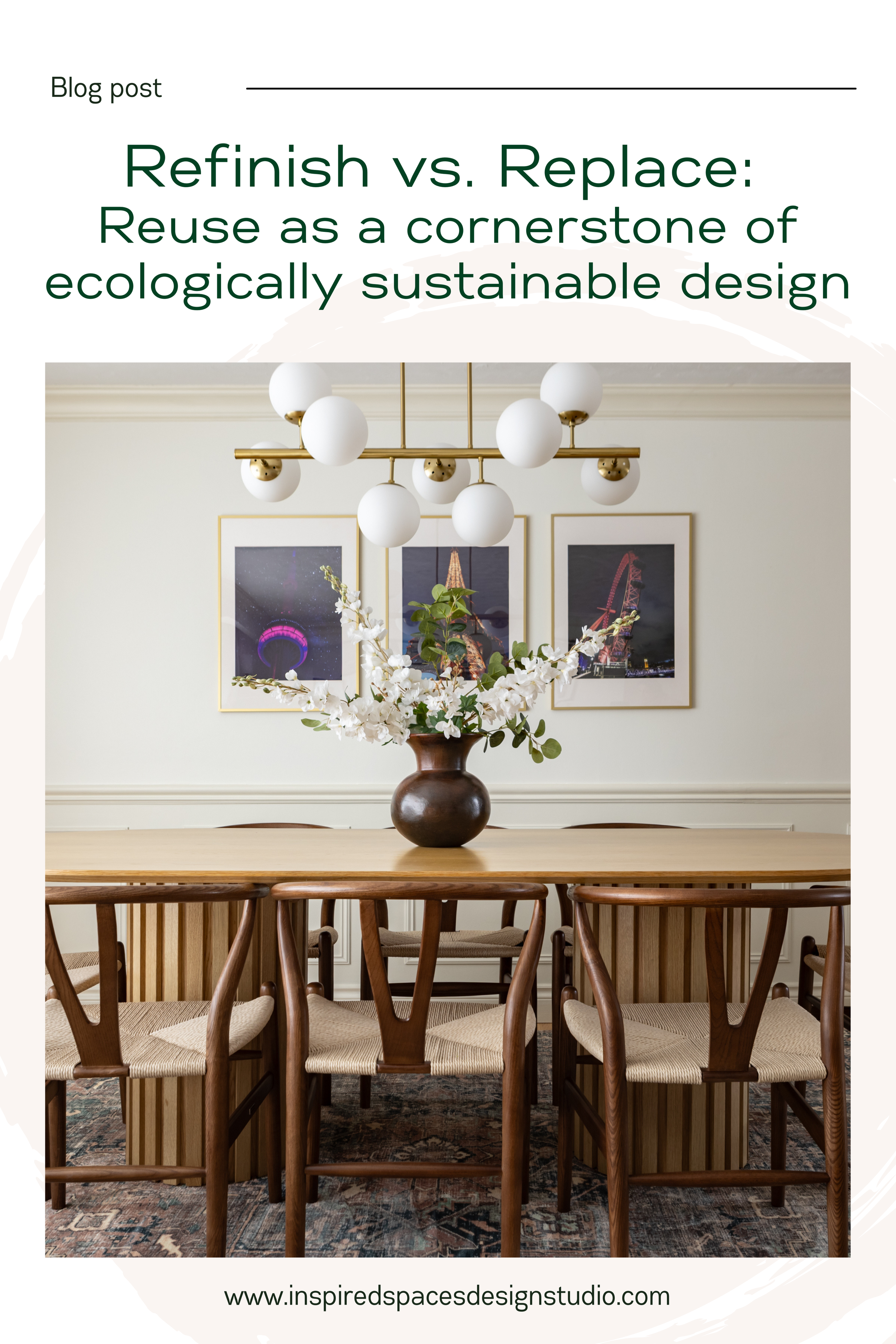
But when it came down to actually designing my new space, watching the many before and after transformations online, I realized that major renovations very often involve complete demolition. Nothing is saved or reused, even when materials are in good condition. There is no discussion of refinishing or repurposing — everything just goes in the bin.
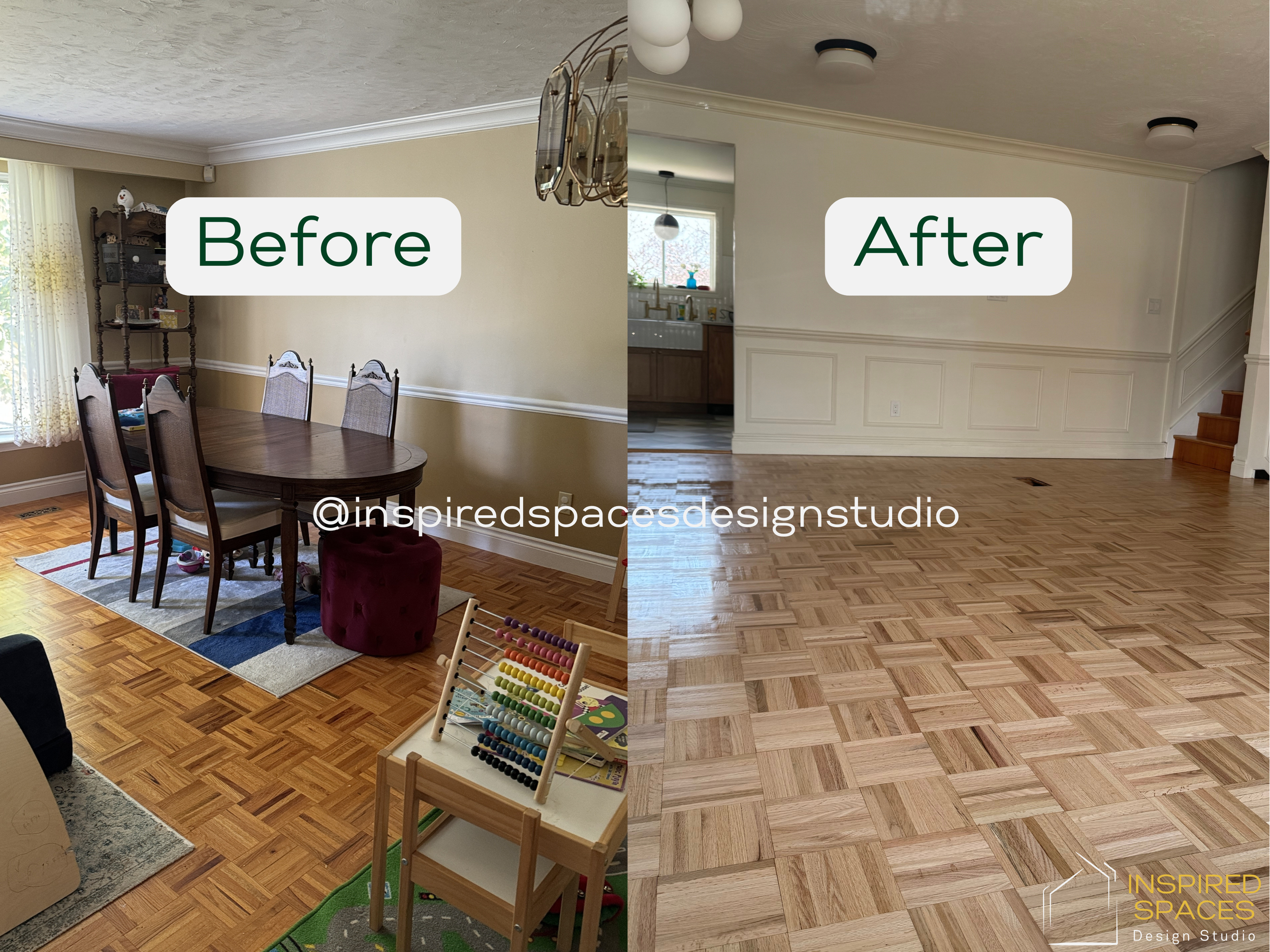
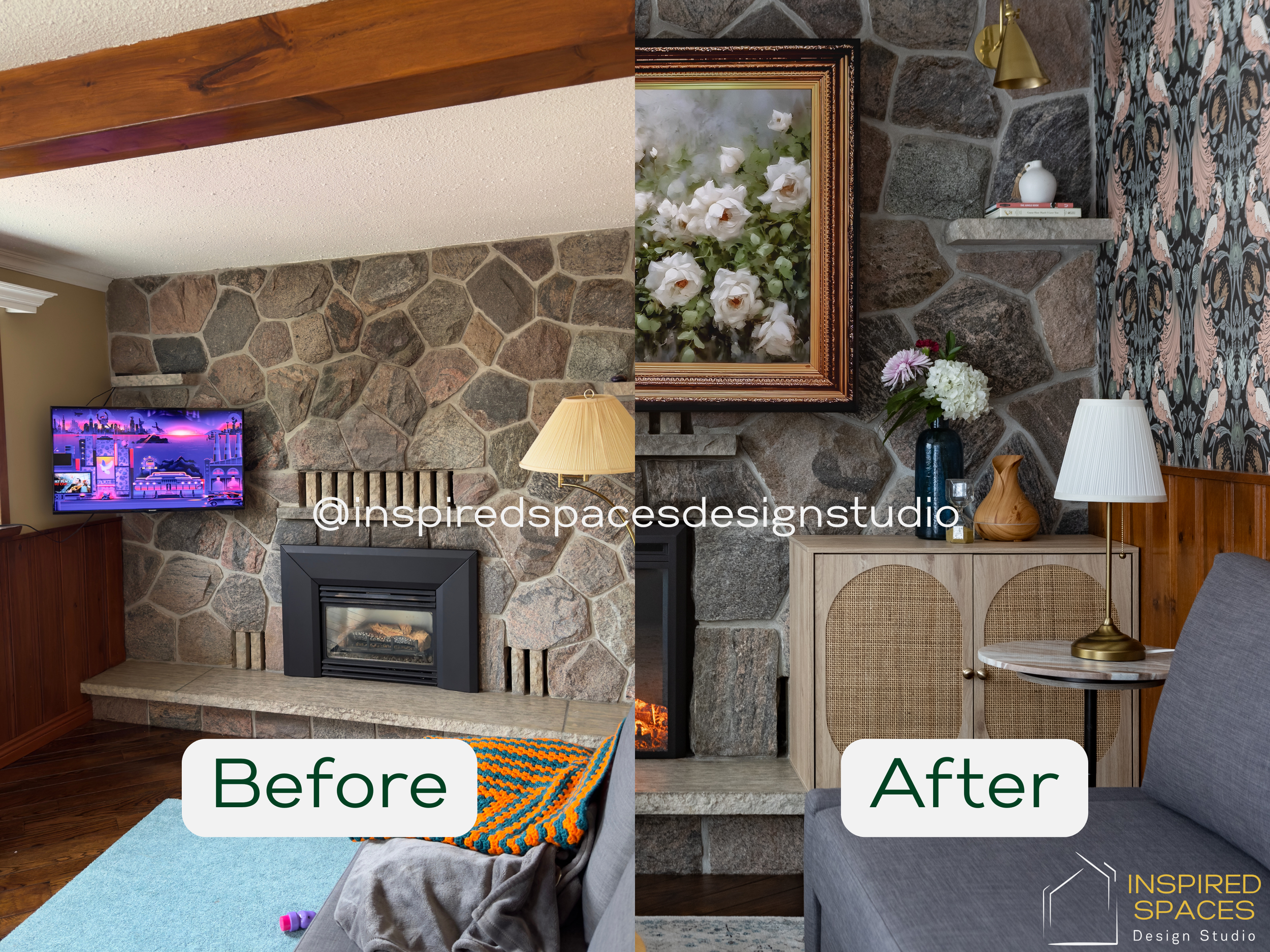
This got me thinking about the landfills that are already overflowing, and the unsustainability and environmental impact of this practice. So as I finalized the design for my own home, I decided to refinish and repurpose what I could. The natural choices were the floors, the half-wall panels in the family room, and the furniture.
The base was already good — they just needed to be spruced up. I was able to refinish the floors at a fraction of the cost of replacing and saved them from the landfill. I kept the half-wall panels and the pre-existing rock wall, and leaned into the cottage feel of the room by adding a bold wallpaper to give it more character. Both choices produced a better outcome than starting from scratch would have.
The numbers behind renovation waste are too significant to ignore. A study (Porwal, 2013) showed that in Canada:
27% of municipal solid waste in landfills comes from construction and demolition waste.
75% of that material still had residual value at the time of disposal. To put it simply, most of what gets thrown out during a renovation does not need to be thrown out.
The global construction industry uses approximately 30% of all raw materials extracted and generates around 30% of the world’s waste (Soto-Paz et al., 2023), and every unnecessary demolition contributes to that figure.
It is normal, and quite human, to desire the latest, the best, the newest. This is probably why most major renovations we see involve complete demolition.
Designers want to follow the latest trends and clients want that Instagram-worthy home. But as global citizens, we are also tasked with the duty to preserve, protect, and enhance our environment for future generations. By incorporating sustainability as a core tenet of our design process, we can be stewards of that change. If interior designers start with a “what can I repurpose here?” mindset, we can guide our clients’ thinking toward reuse and waste reduction. Sometimes it may start as a conversation about cost reduction or time savings — a tangible outcome for the client — to bring us closer to achieving our environmental goals.
The environmental cost of replacing extends further than waste generation. Every new material produced and sourced carries the cumulative greenhouse gas emissions generated from the extraction of raw materials, manufacturing, transportation, and installation — what is known as embodied carbon. Embodied carbon from building materials is responsible for 11% of global emissions (World Green Building Council, 2019).
When we replace perfectly good materials in a renovation, we trigger an entirely new production chain from nature to factory, and a logistics chain from factory to front door.
Beyond waste and emissions, the materials we specify have a direct impact on indoor air quality as many conventional finishes, adhesives, and synthetic materials off-gas volatile organic compounds (VOCs) that have been linked to respiratory issues, allergies, and asthma, particularly in children (Health Canada, 2021).
The irony of replacing materials like hardwood floors is that they are among the most long-wearing and refinishable materials available. By contrast, carpets are less durable, and nearly 90% of carpets that are removed end up in landfill (Changing Markets, 2024). The floor that has been there for twenty years can last another twenty — without a single new tree being harvested. A similar story can be told about cabinetry: the box construction of well-made cabinetry can outlive door and hardware styles, making refinishing or repainting a sound choice that lowers both cost and waste significantly. The designer’s role is to identify these opportunities and build them into the design.
It is becoming increasingly necessary to think about sustainability in design and construction. The designer who prioritizes a “what can I keep here?” mindset over a “clean slate” mindset arrives at more creative solutions.
Sustainability is not a constraint on great design — it can be an enabler of it. Salvaged materials used in unexpected ways become the detail people ask about, and repainted cabinetry with new hardware can read as intentional and well-designed. It is our duty as interior designers to do our part as stewards of the environment and lead the way in sustainable design.
References
Porwal, A. (2013). Construction waste management at source : a Building Information Modeling based system dynamic approach (T). University of British Columbia. Retrieved from https://open.library.ubc.ca/collections/ubctheses/24/items/1.0074315
Soto-Paz, J., Arroyo, O., Luz Elba Torres-Guevara, Brayan Alexis Parra-Orobio, & Casallas-Ojeda, M. (2023). The circular economy in the construction and demolition waste management: A comparative analysis in emerging and developed countries. Journal of Building Engineering, 78, 107724. https://doi.org/10.1016/j.jobe.2023.107724
This essay was originally written for my Commercial Design certification from The Interior Design Institute.